

Language Express milestones

Check your child’s age to find speech and language milestones, play development milestones, teachable moments, things to try at home, and things to watch out for.
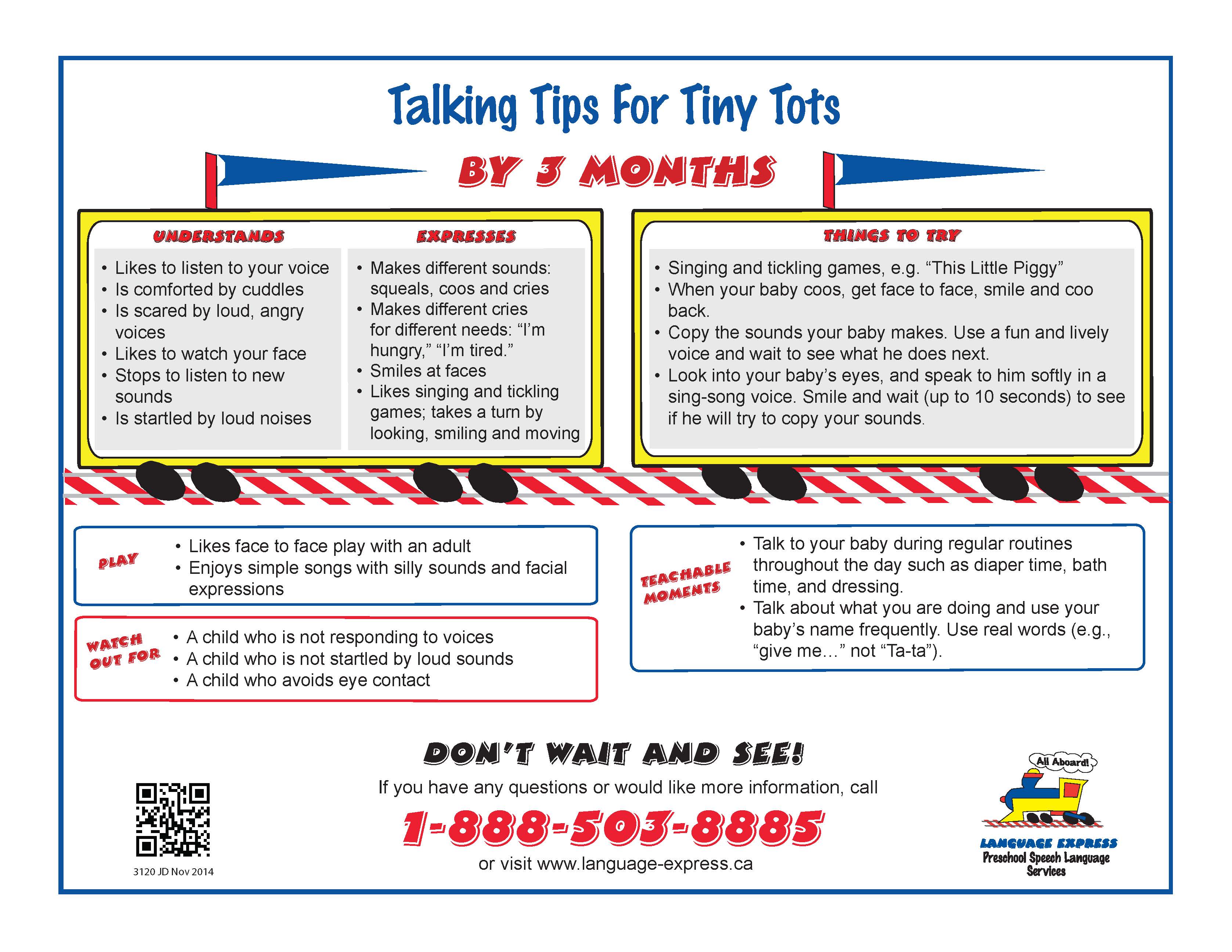
By three months
Understands:
- Likes to listen to your voice.
- Is comforted by cuddles.
- Is scared by loud, angry voices.
- Likes to watch your face.
- Stops to listen to new sounds.
- Is startled by loud noises.
Expresses:
- Makes different sounds, such as squeals, coos, and cries.
- Makes different cries for different needs, such as “I’m hungry,” or “I’m tired.”
- Smiles at faces.
- Likes singing and tickling games; takes a turn by looking, smiling, and moving.
Play development:
- Likes face-to-face play with an adult.
- Enjoys simple songs with silly sounds and facial expressions.
Teachable moments:
- Talk to your baby during regular routines throughout the day, such as diaper time, bath time, and dressing.
- Talk about what you are doing and use your baby’s name frequently. Use real words, such as “give me…” not “ta-ta.”
Things you can try at home:
- Singing and tickling games, such as “This Little Piggy.”
- When your baby coos, get face-to-face, smile, and coo back.
- Copy the sounds your baby makes. Use a fun and lively voice and wait to see what your baby does next.
- Look into your baby’s eyes and speak to them softly in a sing-song voice. Smile and wait (up to 10 seconds) to see if they will try to copy your sounds.
What to watch out for:
- A child who is not responding to voices.
- A child who is not startled by loud sounds.
- A child who avoids eye contact.
Request the Milestones by three months (printable version)
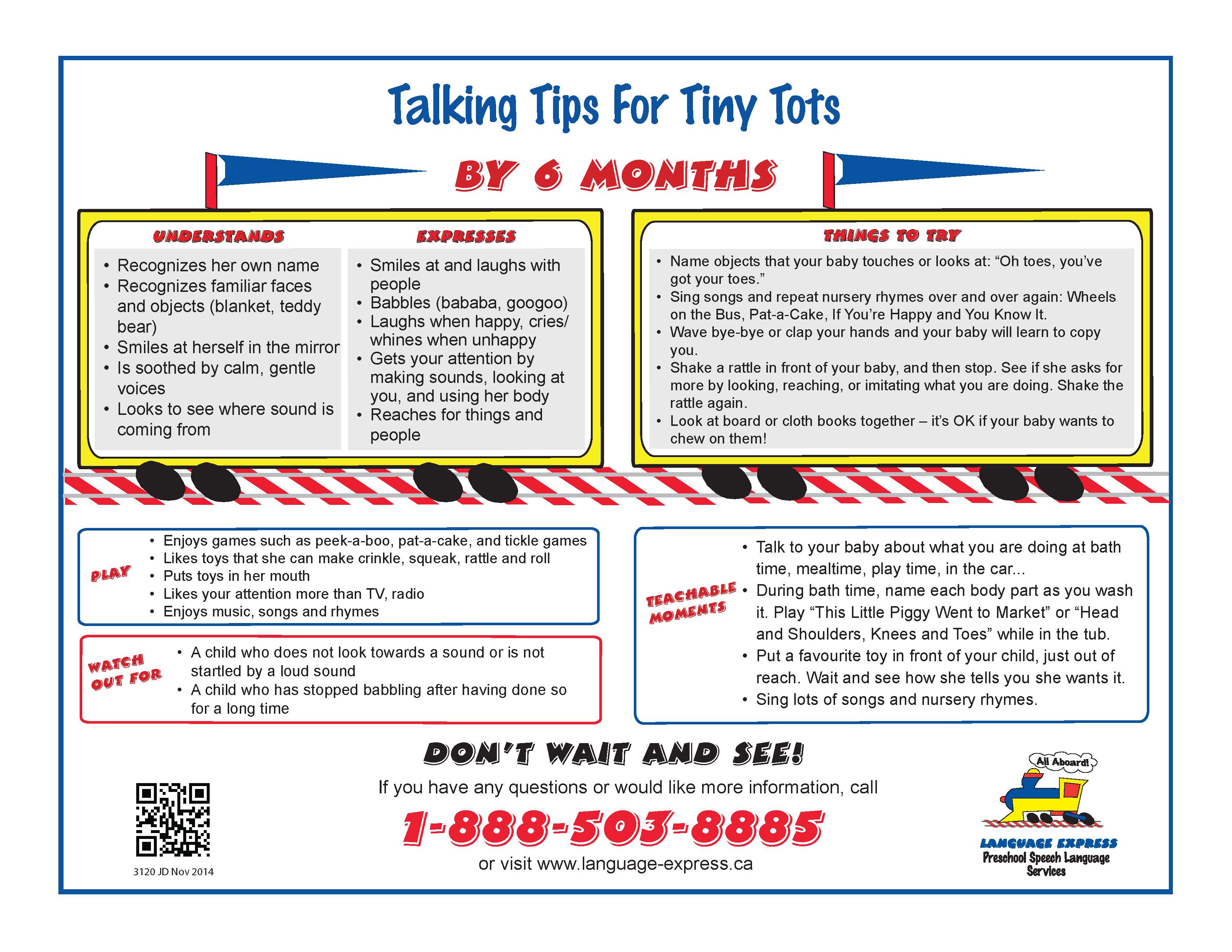
By six months
Understands:
- Recognizes their own name.
- Recognizes familiar faces and objects (blanket, teddy bear).
- Smiles at themself in the mirror.
- Is soothed by calm, gentle voices.
- Looks to see where sound is coming from.
Expresses:
- Smiles at and laughs with people.
- Babbles (bababa, googoo).
- Laughs when happy, cries or whines when unhappy.
- Gets your attention by making sounds, looking at you, and using their body.
- Reaches for things and people.
Play development:
- Enjoys games such as Peek-a-Boo, Pat-a-Cake, and tickle games.
- Likes toys that they can make crinkle, squeak, rattle, and roll.
- Puts toys in their mouth.
- Likes your attention more than the television or radio.
- Enjoys music, songs, and rhymes.
Teachable moments:
- Talk to your baby about what you are doing at bath time, mealtime, play time, and in the car.
- During bath time, name each body part as you wash it. Play “This Little Piggy Went to Market” or “Head and Shoulders, Knees and Toes” while in the tub.
- Put a favourite toy in front of your child, just out of reach. Wait and see how they tell you they want it.
- Sing lots of songs and nursery rhymes.
Things you can try at home:
- Name objects that your baby touches or looks at: “Oh toes, you’ve got your toes.”
- Sing songs and repeat nursery rhymes over and over again: “Wheels on the Bus,” “Pat-a-Cake,” and “If You’re Happy and You Know It.”
- Wave bye-bye or clap your hands, and your baby will learn to copy you.
- Shake a rattle in front of your baby and then stop. See if they ask for more by looking, reaching, or imitating what you are doing. Shake the rattle again.
- Look at board or cloth books together. It’s OK if your baby wants to chew on them!
What to watch out for:
- A child who does not look toward a sound or is not startled by a loud sound.
- A child who has stopped babbling after having done so for a long time.
Request the Milestones by six months (printable version)
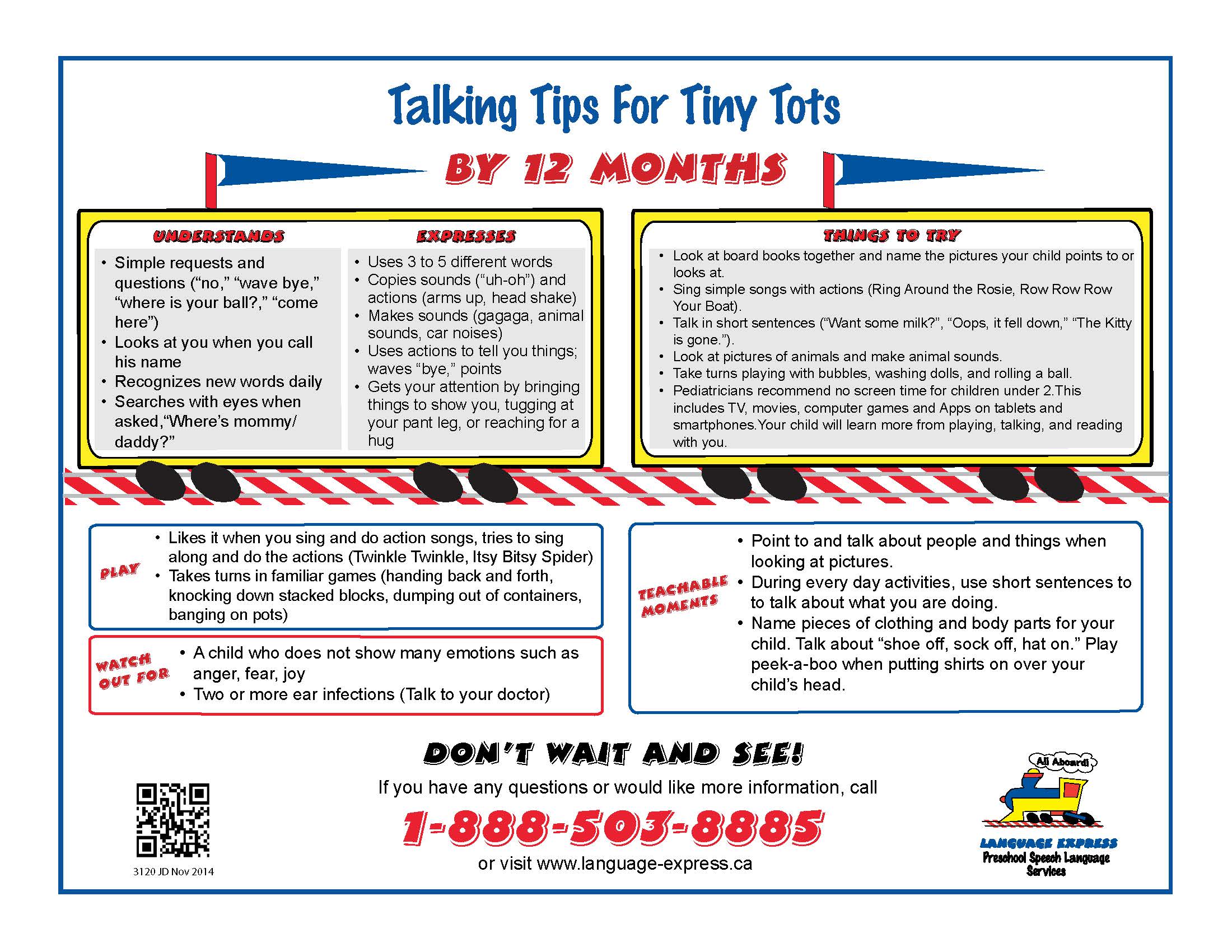
By 12 months
Understands:
- Simple requests and questions such as “no,” “wave bye,” “where is your ball?” or “come here.”
- Looks at you when you call their name.
- Recognizes new words daily.
- Searches with eyes when asked, “Where’s mommy/daddy?”
Expresses:
- Uses three to five different words.
- Copies sounds (“uh-oh”), and actions (arms up, head shake).
- Makes sounds (gagaga, animal sounds, car noises).
- Uses actions to tell you things, waves “bye,” or points.
- Gets your attention by bringing things to show you, tugging at your pant leg, or reaching for a hug.
Play development:
- Likes it when you sing and do action songs. Tries to sing along and do the actions in songs such as “Twinkle Twinkle,” or “Itsy Bitsy Spider.”
- Takes turns in familiar games (handing back and forth, knocking down stacked blocks, dumping out of containers, or banging on pots).
Teachable moments:
- Point to and talk about people and things when looking at pictures.
- During everyday activities, use short sentences to talk about what you are doing.
- Name pieces of clothing and body parts for your child. Talk about “shoe off, sock off, hat on.” Play Peek-a-Boo when putting shirts on over your child’s head.
Things you can try at home:
- Look at board books together and name the pictures your child points to or looks at.
- Sing simple songs with actions such as “Ring Around the Rosie” or “Row, Row, Row Your Boat.”
- Talk in short sentences (“Want some milk?”, “Oops, it fell down”, “The kitty is gone”).
- Look at pictures of animals and make animal sounds.
- Take turns playing with bubbles, washing dolls, and rolling a ball.
- Pediatricians recommend no screen time for children under two. This includes television, movies, computer games and apps on tablets and smartphones. Your child will learn more from playing, talking, and reading with you.
What to watch out for:
- A child who does not show many emotions such as anger, fear, or joy.
- Two or more ear infections (talk to your doctor).
Request the Milestones by 12 months (printable version)
By 18 months
Understands:
- Understands more than they can say.
- Responds to simple questions with words or actions (“Where are your shoes?”).
- Follows simple instructions (“Show me the…” or “Give me the…”).
- Points to three body parts when asked.
- Points to pictures you name in books or photos.
- Understands “in,” “out,” “off,” and “on.”
Expresses:
- Says at least 20 words; words may not be clear, such as “Mama” for “Mommy,” or “Ba” for “Ball.”
- Says “No.”
- Copies animal sounds.
- Asks for something by pointing and using sounds or words (points to cookie and says, “num num.”).
- Uses at least four of these sounds: p, b, m, n, d, t, w, h.
Play development:
- Pretends with toys (gives teddy a drink).
- Enjoys making things happen (pop-up toys, wind-up toys).
- Moves to music (definitely dancing!).
- Looks at you when you are talking and playing together.
Teachable moments:
- Point to and name body parts when dressing and at bath time.
- Go for a walk. Point to and name the sounds your child hears. Point to the things they see. Collect things along the way (leaves, stones, flowers). Talk about what they’re doing in simple words, repeating them over and over again.
- Read books together. Wait for your child to point to something, say the word for them, then add a little bit more. “A bird, that’s right… a bird. The bird is flying.”
Things you can try at home:
- Let your child hold a book and name the pictures they touch or look at.
- Use real words, such as “Give me,” not “Ta-ta.”
- Sing action songs over and over (“Itsy Bitsy Spider” or “Little Rabbit Foo-Foo”). Stop in the middle, wait for your child to take a turn or do an action, then continue together.
- Put objects in containers and shake them. Open and close them, then dump them out. Add words like “in,” “out,” “more,” “open,” and “shake” while you talk.
- Try on your child’s socks and say, “Too small.” Have your child try on your hat, and say, “Mommy’s hat is too big!” Try lots of other clothes too!
What to watch out for:
- A child who is not trying to talk.
- A child who doesn’t bring things to show you or give to you.
- A child who doesn’t take turns (for example, roll a ball back and forth).
- Repeated ear infections (talk to your doctor).
Request the Milestones by 18 months (printable version)
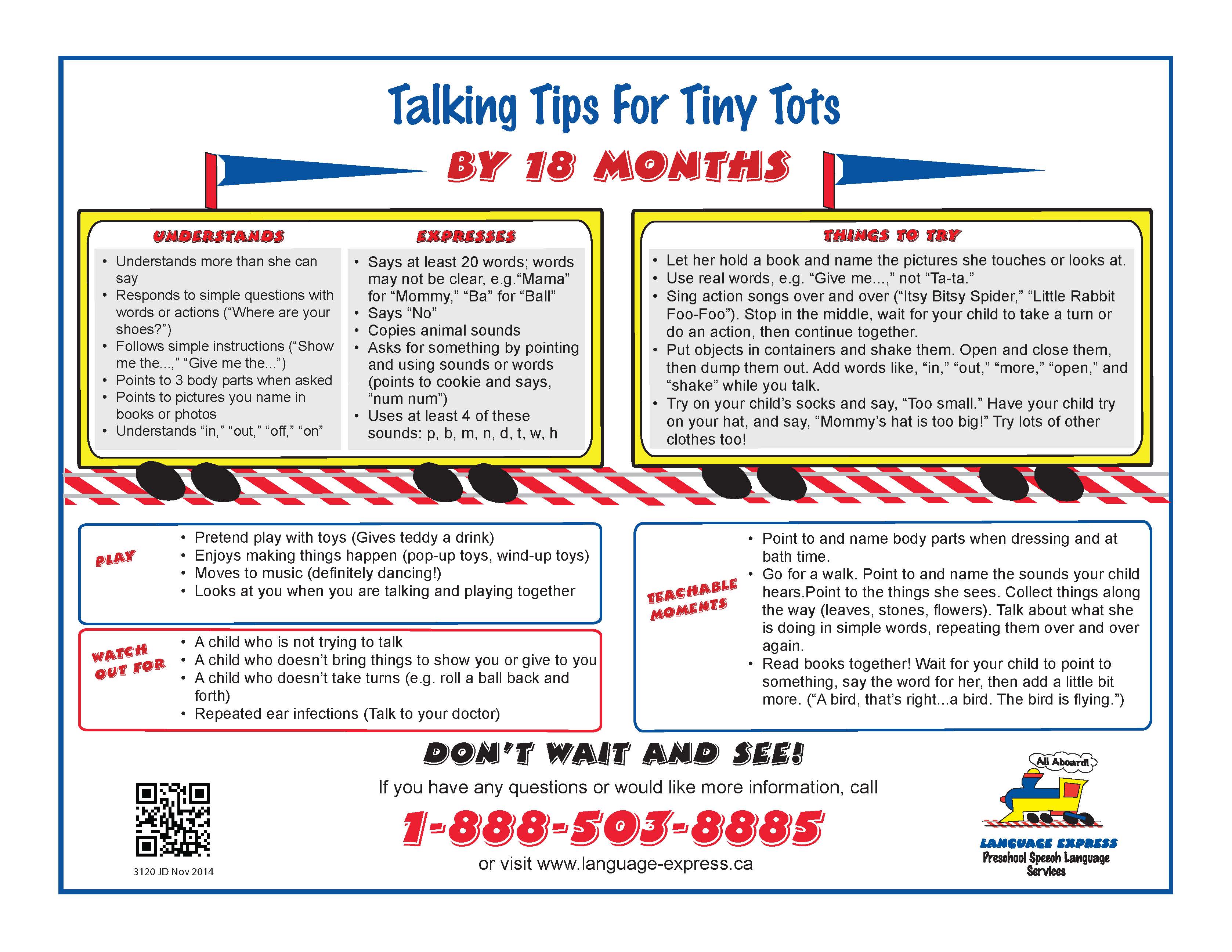
By two years
Understands:
- Follows two-step instructions such as “Go find your teddy and give it to Grandma.”
- Understands more than they can say.
- Points to most body parts and familiar objects (“Show me your knee,” or “Where’s the ball?”).
- Answers questions correctly with “yes” or “no.”
- Answers “what” and “where” questions correctly.
Expresses:
- Uses 100 to 150 words.
- Uses many different speech sounds at the beginning of words: p, b, m, t, d, n, h, w.
- Tries to say or copy words you say, but may not always be clear.
- Uses two or more new words a week.
- Combines at least two words into a phrase (“moe tee” for “more cheese”).
- Asks “What’s that?” and “Where?”
- Forms words and sounds easily.
Play development:
- Likes to play alone or beside other children.
- Begins to take turns with other children (run and chase games).
Teachable moments:
- Choose books with large clear pictures. Make up your own story or take turns pointing to and talking about people and things in the pictures.
- Hide toys under/behind pillows, blankets and furniture. Have fun asking, “Where?”
- Expand your child’s world: meet new people, go to the library and choose books, go to new places, share toys with friends.
Things you can try at home:
- Use lots of different words, like action words such as “run” and “push”, location words such as, “in” and “under”, and describing words such as “wet,” “hot,” “little,” or “happy.”
- If you don’t understand your child, repeat a word you did understand, or ask them to show you.
- Give your child a choice of songs to sing with actions, and sing along (“Wheels on the Bus,” “Old MacDonald”).
- Wait… and let your child talk first. What they say might surprise you!
- Repeat what they say in short but correct sentences (Child: “There cat!” Adult: “Yes, there is a cat.”).
- Television, computer games, and apps cannot teach your child to talk. They learn from talking and playing with you.
What to watch out for:
- A child who doesn’t respond to their name or look at you when you talk to them.
- A child who used to say many words but is no longer saying much.
- Repeated ear infections (talk to your doctor).
Request the Milestones by two years (printable version)
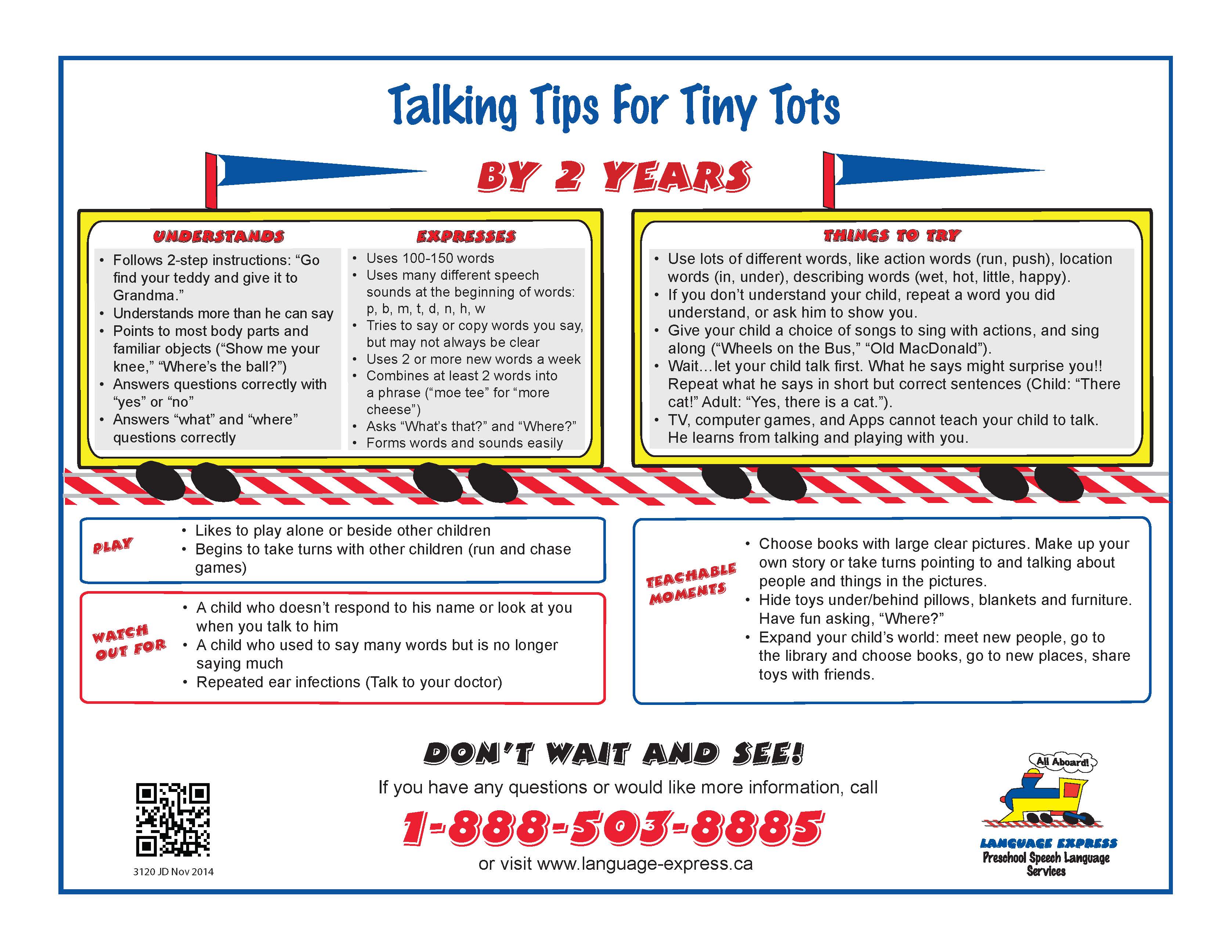
By 30 months
Understands:
- Understands more complex language than they use.
- Understands words that describe such as “hot,” “big,” “little,” “sticky,” “wet,” “a little,” “a lot,” and “more.”
- Puts objects “in,” “on,” or “under” when asked.
- Finds common objects and points to pictures when asked (“Show me the brush.”).
- Remembers and understands familiar stories.
Expresses:
- Uses more than 350 words.
- Uses some adult grammar (“Two cookies,” “Bird flying,” “Daddy’s car”).
- Starting to say three or more words together.
- Uses “I,” “you,” “mine,” and “me.”
- Uses words to answer “what” and “where” questions.
- Uses a variety of consonant sounds: p, b, m, n, t, d, w, h.
- Uses action words such as “run,” “spill,” and “fall.”
Play development:
- Enjoys being around children, and takes short turns with them using both toys and words.
- Puts together pretend actions (wash a doll, dry it off, then put it to bed).
- Likes to play dress-up and act out things they see you do (cook, brush hair, feed baby).
Teachable moments:
- Listen to music and move around the room. Talk about your actions (spin, dance, jump, hop, skip, over, under, around).
- Craft time! Create art work together with paint, glue, crayons, or play dough. Talk about what you are making.
- Encourage your child to play with other children (playgroups, park, library).
Things you can try at home:
- Repeat what your child says in a short sentence with correct grammar. If your child says: “I see truck,” you say, “I see a big truck.”
- Make play fun! Use your child’s energy to practise following directions (“Clap your hands.” or “Jump up and down.”).
- Describe things you see or feel (rough, soft, heavy, empty, full, same, different).
- Read books together. Children like lift-the-flap books, and touch-and-feel books.
- Play pretend with your child (tea parties, firefighter, house).
What to watch out for:
- A child who is not combining words.
- A child who is very difficult to understand, even for their parents.
- A child who appears to be losing the ability to talk.
- A child who doesn’t pretend.
Request the Milestones by two and a half years (printable version)
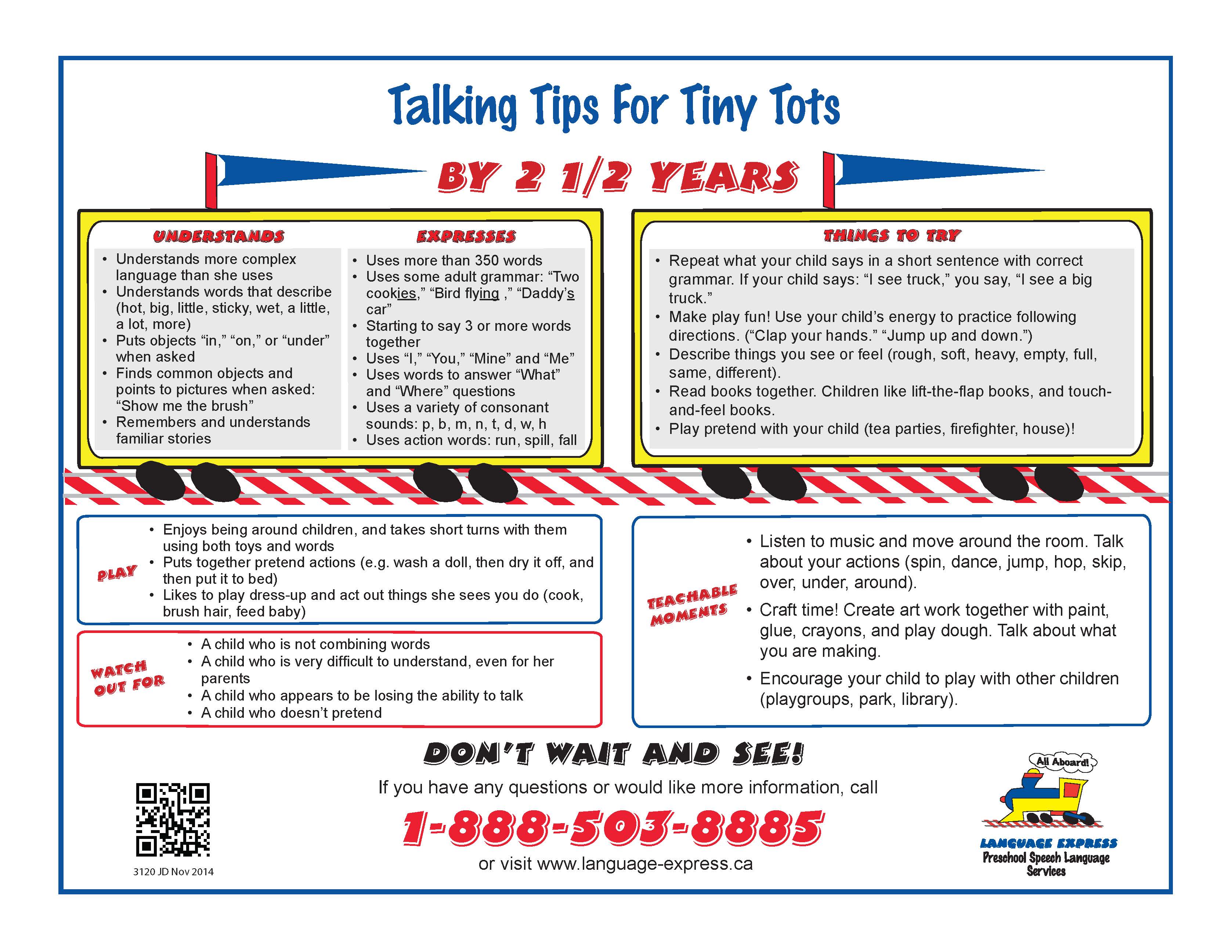
By three years
Understands:
- Understands same/different, one/all, light/heavy, night/day.
- Understands “who,” “what,” “where,” and “why” questions.
- Can find items that belong together such as clothes or food.
- Can solve simple puzzles (“Your hands are dirty. What should you do?”).
Expresses:
- Says four to seven words in a sentence (“I want my red ball.”).
- Asks “who?”, “what?”, “where?”, and “why?” questions.
- Can talk about something that happened in the past such as a trip to Grandma’s.
- Can tell a simple story.
- Adults outside your family understand at least half of what your child says.
- Can clearly make these sounds in words: p, b, m, n, h, w, d.
Play development:
- Begins to play co-operatively with other children.
- Enjoys short periods of pretend play such as playing house, pretend shopping, or pretending to be Mommy/Daddy.
Teachable moments:
- Point to the words as you read to your child.
- Ask them to be your helper and give them small jobs to do.
- Read books with pictures and take turns telling stories about the pictures.
- Play make-believe with or without toys (pretend to go shopping, play dress-up, play with pretend toy garages, doll houses, or kitchen sets).
- Sort pieces of clothing while doing the laundry together (sort by colours, to whom it belongs, types of clothing).
Things you can try at home:
- Read rhyming books and say nursery rhymes. Play rhyming games like “mat,” “bat,” “cat,” and “hat.”
- Describe things in sentences (“I am really hungry,” or “That’s a huge bite!”).
- Repeat what your child says, using correct sounds and sentences (Child: “Me want doose.” Adult: “I want juice too. I like juice.”).
- Talk about the ways things around you are the same/different. Sort things using colour, shape, size, and location.
- Give your child lots of chances to choose (“Do you want a pear or an apple?”, “Do you want to wear the red shirt or the blue shirt?”).
What to watch out for:
- A child who drools a lot or who is a very messy eater.
- Periods of stuttering lasting longer than three months.
- A child who rarely makes eye contact and avoids being with others.
- A child who is very difficult to understand, even for their parents.
Request the Milestones by three years (printable version)
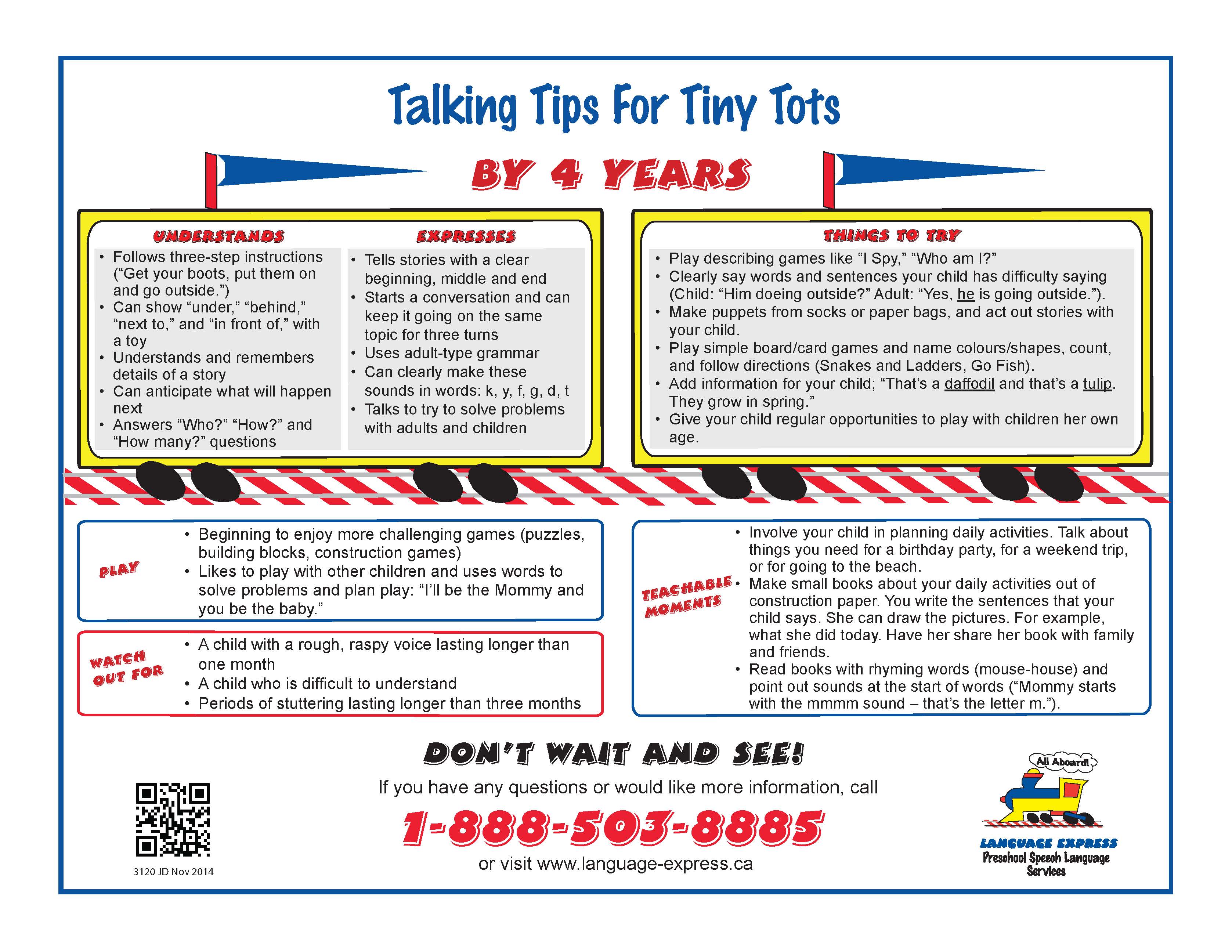
By four years
Understands:
- Follows three-step instructions such as “Get your boots, put them on and go outside.”
- Can show “under,” “behind,” “next to,” and “in front of” with a toy.
- Understands and remembers details of a story.
- Can anticipate what will happen next.
- Answers “who?”, “how?”, and “how many?” questions.
Expresses:
- Tells stories with a clear beginning, middle, and end.
- Starts a conversation and can keep it going on the same topic for three turns.
- Uses adult-type grammar.
- Can clearly make these sounds in words: k, y, f, g, d, t.
- Talks to try to solve problems with adults and children.
Play development:
- Beginning to enjoy more challenging games (puzzles, building blocks, construction games).
- Likes to play with other children and uses words to solve problems and plan play (“I’ll be the Mommy and you be the baby.”).
Teachable moments:
- Involve your child in planning daily activities. Talk about things you need for a birthday party, for a weekend trip, or for going to the beach.
- Make small books of your daily activities out of construction paper. You write the sentences that your child says. They can draw the pictures. For example, what they did today. Have them share their book with family and friends.
- Read books with rhyming words (mouse-house) and point out sounds at the start of words (“Mommy starts with the mmmm sound – that’s the letter M.”).
Things you can try at home:
- Play describing games like “I Spy,” and “Who am I?”
- Clearly say words and sentences your child has difficulty saying (Child: “Him doeing outside?” Adult: “Yes, he is going outside.”).
- Make puppets from socks or paper bags, and act out stories with your child.
- Play simple board or card games and name colours and shapes, count, and follow directions (Snakes and Ladders, Go Fish).
- Add information for your child; “That’s a daffodil and that’s a tulip. They grow in spring.”
- Give your child regular opportunities to play with children their own age.
What to watch out for:
- A child with a rough, raspy voice lasting longer than one month.
- A child who is difficult to understand.
- Periods of stuttering lasting longer than three months.
Request the Milestones by four years (printable version)
By five years
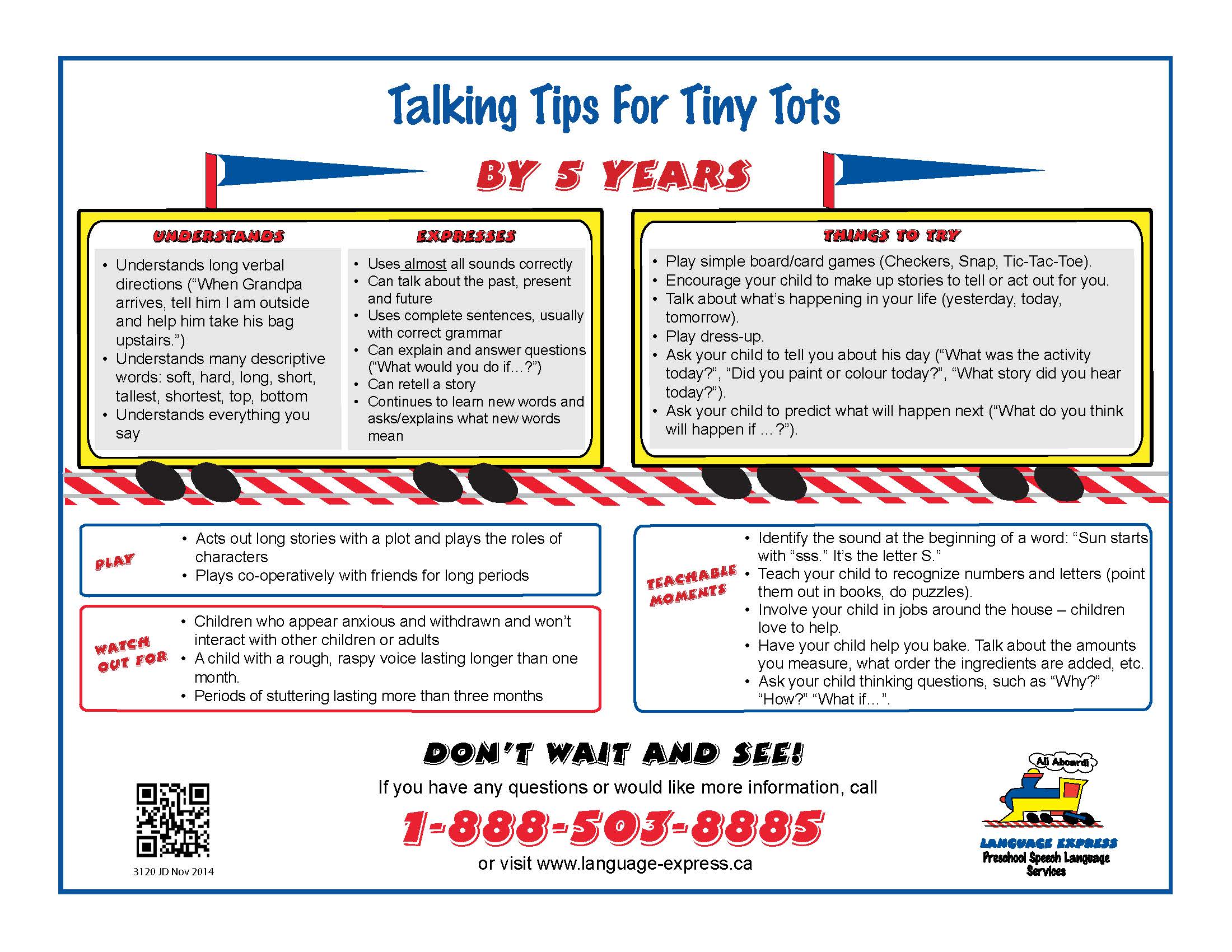
Understands:
- Understands long verbal directions (“When Grandpa arrives, tell him I am outside and help him take his bag upstairs.”).
- Understands many descriptive words: soft, hard, long, short, tallest, shortest, top, bottom.
- Understands everything you say.
Expresses:
- Uses almost all sounds correctly.
- Can talk about the past, present, and future.
- Uses complete sentences, usually with correct grammar.
- Can explain and answer questions like “What would you do if…?”
- Can retell a story.
- Continues to learn new words and asks about or explains what new words mean.
Play development:
- Acts out long stories with a plot and plays the roles of characters.
- Plays co-operatively with friends for long periods.
Teachable moments:
- Identify the sound at the beginning of a word: “Sun starts with sss. It’s the letter S.”
- Teach your child to recognize numbers and letters by pointing them out in books, or doing puzzles.
- Involve your child in jobs around the house—children love to help.
- Have your child help you bake. Talk about the amounts you measure, what order the ingredients are added, and other steps.
- Ask your child thinking questions, such as “Why?”, “How?”, or “What if…?”
Things you can try at home:
- Play simple board or card games like Checkers, Snap, or Tic-Tac-Toe.
- Encourage your child to make up stories to tell or act out for you.
- Talk about what’s happening in your life (yesterday, today, tomorrow).
- Play dress-up.
- Ask your child to tell you about their day (“What was the activity today?”, “Did you paint or colour today?”, “What story did you hear today?”).
- Ask your child to predict what will happen next (“What do you think will happen if…?”).
What to watch out for:
- Children who appear anxious and withdrawn and won’t interact with other children or adults.
- A child with a rough, raspy voice lasting longer than one month.
- Periods of stuttering lasting more than three months.
Request the Milestones by five years (printable version)
Milestone videos
1-888-503-8885 or 613-283-2742
